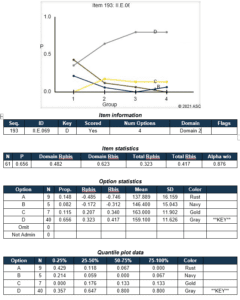
Xcalibre 4is the most user-friendly software available for item response theory (IRT) analysis. An update has been recently released, which includes a number of bug fixes and enhancements, including an addition of distractor (quantile) plots into the output. These plots provide an excellent method for evaluating multiple-choice distractors by combining IRT and classical test theory. We have also added a new fit plot with standard errors to the report document and percentiles to the scores spreadsheet. Current license holders can download the no-cost update from http://www.assess.com/xcart/pages.php?pageid=10. If you do not yet have Xcalibre 4, a free demo version is available at http://www.assess.com/xcart/product.php?productid=569.
Iteman 4 updates
We have also released an update for Iteman 4, the leading software for analysis with classical test theory (CTT). This update focuses on bug fixes and maintenance. If you have a current license, you can download the update at http://www.assess.com/xcart/pages.php?pageid=10. If you do not yet have Iteman 4, a free demo version is available at http://www.assess.com/xcart/product.php?productid=541.
Conferences page on ASC website updated for 2012
ASC provides a number of resources to professionals in the field of testing and psychometrics, including a list of major conferences in the field. We have updated that list for 2012 at http://www.assess.com/conferences.php... see where you want to go! ASC has plans to be at the SIOP, IACAT, and ICE conferences.
Connect with ASC on LinkedIn
LinkedIn is an essential social networking site for professionals of all fields. It marks an important advancement in professional connectivity. ASC has had a page on LinkedIn for a number of years; if you aren't already following us, please visit http://www.linkedin.com/company/assessment-systems-corporation. We also update our news at the ASC blog.
Free training videos released
ASC hosts one or two workshops every year (one workshop was just recently held, January 23-25 in Brazil) and presents at a number of conferences, but we realize that not everyone is able to attend. Therefore, ASC is publishing a set of tutorial videos on our software and important issues in psychometrics, like item response theory and computerized adaptive testing. The videos are available for free at http://www.assess.com/tutorials.php. Two have been completed so far: Running Iteman 4 and Interpreting Iteman 4 Output.
ASC to present at 2012 SIOP Conference
ASC will present a mini-workshop on the development of computerized adaptive tests (CATs) at the Society for Industrial-Organizational Psychology (SIOP) conference. The session is scheduled for 1:30 PM on Friday, April 27. More information is available at the SIOP website.
Important links
ASC Website (Home)
ASC blog
ASC LinkedIn
FastTest Web - Secure Online Adaptive Testing
FastTest Web Facebook page
FastTest Web Twitter page
Student grants for free software
The third conference of the International Association for Computerized Adaptive Testing (IACAT) will be held at the Sydney Convention Centre (www.scec.com.au), Australia from Sunday 12 to Tuesday 14 August 2012. This conference follows the successful first conference held in the Netherlands in June 2010 and the second conference held in Monterey in October 2011. It is jointly organized by the Australian Medical Council (AMC) (www.amc.org.au) and Excel Psychological and Educational Consultancy (EPEC) (www.epecat.com).

The theme of the conference is "CAT - the past, present and future" and the program is designed to facilitate the exchange of ideas, research and applications of CAT. Besides invited keynote addresses and symposia by global leaders in the field, there will be pre-conference workshops at the introductory and advanced levels.
The program committee invites you to join us in Sydney. Sydney is a vibrant, multi-cultural and cosmopolitan city which, as the largest city in Australia, has much to offer.
Proposal abstracts can already be submitted to IACATconference2012@amc.org.au Abstracts should be submitted in 12pt Times New Roman MS Word (max of 500 words) and include a title, name and email address of the presenter(s), institutional affiliation and a topic area.
Information about accommodation and registrations will soon be available through a designated conference website. For further information at this stage contact IACATconference2012@amc.org.au or visit www.iacat.org.
I have just returned from a workshop on item response theory (IRT) and computerized adaptive testing (CAT), held January 23-25 in Brasilia, Brazil. The workshop was a resounding success, with attendees from all across Brazil as well as a few international attendees. I'd like to thank CESPE (http://www.cespe.unb.br/) and INEP (http://www.inep.gov.br/) for making it possible. Muito obrigado!
We've all seen "all of the above" or "none of the above" items in tests we have taken, mostly in low-stakes situations... because these items are frowned upon by psychometricians and testing experts. The item options are no longer independent, and an item of that format will give away the answer more often than standard items, especially because the correct answer usually is AOTA or NOTA. Therefore, these items should be modified to format more in concordance with best practices.
Here are three approaches to rearranging items with "All of the above" or related issues. Consider the following question as an example.
Which of the following is a city in Florida?
A. Miami
B. Tampa
C. Jacksonville
D. All of the above*
1. Make an AOTA into a single answer by setting one of the answers as correct and flipping the rest to incorrect. Example:
Becomes...
Which of the following is a city in Florida?
A. Milwaukee
B. Tampa*
C. Phoenix
D. Chicago
2. Make answers into combinations by actually writing out the terms with more than one in each option. This is similar to the previous suggestion, but usually makes the item more difficult.
Which of the following lists two cities in Florida?
A. Miami and Tampa
B. Tampa and Milwaukee
C. Chicago and Milwaukee
D. Phoenix and Chicago
3. If you can't think of any plausible incorrect answers (sometimes the case), try flipping the stem and options to get something like:
Miami, Tampa, and Jacksonville are cities in__________.
A. Florida
B. Alabama
C. California
D. Georgia
Social Media has become an integral part of life and business over the past 5 years. In fact, one of ASC's clients is a certification agency for social media specialists: http://nismonline.org/. ASC recognizes this important step in world connectivity and has been a part of social media for a few years. In addition to this blog, here are a few important links:
LinkedIn (ASC): http://www.linkedin.com/company/assessment-systems-corporation
Facebook (FastTest Web): http://www.facebook.com/pages/FastTEST-Web/123132391080511
Twitter (FastTest Web): http://twitter.com/FastTESTWeb
We encourage you to connect with ASC via these platforms, especially LinkedIn! Of course, we will continue to send out news and announcements via our email list, www.assess.com, and www.fasttestweb.com.
Did you know that grants are available to purchase ASC software for graduate students? If you are a student, or a faculty member who is supervising graduate students, please visit http://www.assess.com/xcart/pages.php?pageid=5 for more information. We also make our software available free for a semester to students in your classes or graduate students who need our software for their research for up to four months.
"Adaptive testing" has become a buzzphrase in testing circles over the past decade, especially in K-12 assessment. Unfortunately, very few people who hear the phrase, are interested in adaptive tests, or are even using adaptive tests, have any idea what goes into them. ASC gets a number of inquiries regarding the development of adaptive tests from organizations or individuals that are not familiar with the fundamentals of adaptive testing or the basic requirements that must be met to even think about developing adaptive tests. For example, you must have a pilot sample of at least 100 examinees, preferably 500 - and CAT is still often not feasible unless you are testing thousands of examinees. Therefore ASC psychometricians have published two important resources on the topic: a journal article describing the development of adaptive tests (http://pareonline.net/pdf/v16n1.pdf) and a white paper describing the basic requirements for a testing program to even consider adaptive testing (http://www.fasttestweb.com/ftw-docs/CAT_Requirements.pdf). These are essential readings for anyone involved with modern assessments.